
About
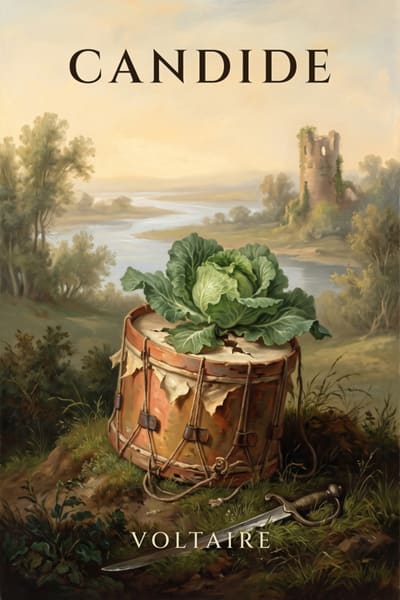
Candide follows a guileless young man expelled from a Westphalian castle whose episodic travels across Europe and the Americas expose him to war, injustice, and absurdity. Voltaire's prose is brisk, ironic and savage in equal measure, shifting from fairy-tale simplicity to savage satirical set-pieces. The novella is distinguished by its ruthless parody of contemporary philosophy and institutions and its lasting clarity as a compact Enlightenment critique of optimism.
Theme
A sustained critique of philosophical optimism: the text dramatizes how abstract doctrines (especially Leibnizian claims that 'all is for the best') collapse when confronted with concrete suffering. Exposure of institutional hypocrisy: religious, judicial and aristocratic authorities are shown as corrupt, self‑serving and often cruel. The moral consequences of colonialism and commercial capitalism: voyages and plantation scenes reveal slavery, exploitation and commodification as integral to European wealth. Practical humanism as an antidote to abstract systems: the story ultimately valorizes modest, sensible work and concrete solidarity over speculative metaphysics.
Setting
The narrative begins in an aristocratic castle in Westphalia and then unfolds as an episodic, globe‑spanning journey through European courts and cities, wartime battlefields, South American colonies (including Surinam and Buenos Ayres), the legendary Eldorado, and various Mediterranean and Ottoman locales. Settings range from insulated aristocratic domesticity to urban bureaucracies, colonial plantations, and refugee‑strewn landscapes; the shifting geography functions symbolically to test philosophical claims against the realities of war, poverty, religious power, and commerce.
Historical Content
Written in 1759 during the European Enlightenment, Candide is shaped by mid‑18th‑century debates over Leibnizian optimism, the advance of secular reason, and the moral consequences of expanding colonial empires. Its satire responds to events and currents such as the intellectual disputes between rationalists and theologians, the censorship and power of institutions like the Inquisition, the violence of contemporary warfare (the Seven Years' War era), and the Atlantic slave trade and mercantile exploitation that accompanied European imperial expansion.