


About
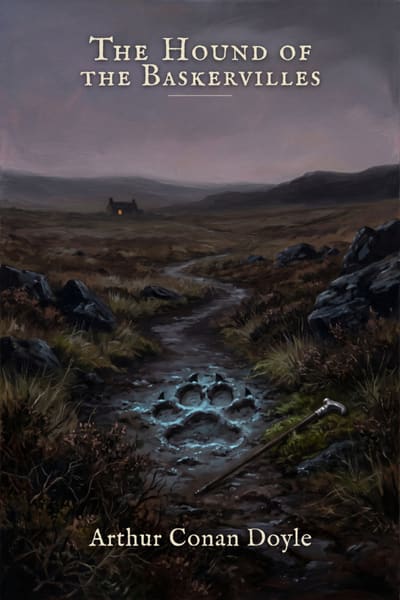
When Dr. Mortimer brings news of a dead heir and an ancient, spectral hound stalking the Devon moor, Sherlock Holmes and Dr. Watson are drawn into a tense investigation that mixes measured deduction with brooding gothic atmosphere. Conan Doyle’s prose alternates crisp forensic detail and wry urbane observation with moorland imagery that is eerie and elemental. The novel stages a collision between scientific inquiry and local superstition, producing a tightly plotted, atmospheric detective classic that helped define the modern mystery novel.
Theme
The tension between scientific rationalism and local superstition, dramatised by Holmes’s methodical inquiry confronting a community’s belief in a family curse; the construction of truth through evidence, inference, and the careful reading of misleading signs; the weight of heredity and the mythology of ancestral doom as it shapes identity and behaviour; and the way landscape and isolation amplify fear, secrecy and moral vulnerability.
Setting
Primarily the isolated West Country of England—bleak Devon moorland, Grimpen Mire, and the ancestral Baskerville Hall—contrasted with brief sequences in London (Holmes’s rooms). The physical landscape is rural and atmospheric: open, misted moors, peat bogs and lonely tors that function as liminal, menacing spaces. Socially the world is stratified: an aristocratic baronet and household retainers, local country doctors and naturalists, and marginalized figures such as escaped convicts and itinerant laborers.
Historical Content
The story is rooted in turn-of-the-century Britain, written amid late-Victorian and early Edwardian cultural currents: the professionalisation of medicine and forensic science, public interest in criminology, and debates over Darwinian atavism and social degeneration. It reflects anxieties about urban modernity versus the perceived archaic dangers of the countryside, the authority of scientific rationalism over folklore, and classed social hierarchies—landed gentry, country servants, and itinerant criminals—shaped by the period’s legal and penal systems.