

About
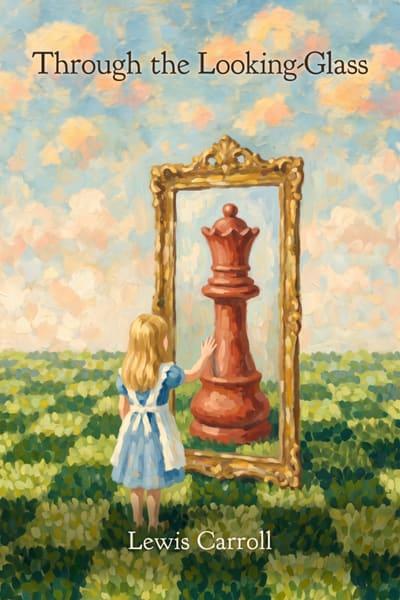
A curious girl named Alice steps through a mirror into an inverted, chessboard world where nursery-room logic and courtly absurdity collide. Carroll’s prose is playful, punning and vividly imagistic, sliding between whimsical storytelling and sharp, mathematical wit. The book is notable for its linguistic invention (from nonsense verse to coinages), its chess-structure that shapes Alice’s progress, and its sustained satire of adult rules seen from a child’s eye.
Theme
1) The instability of language and meaning: the text dramatizes how words can be bent, redefined and weaponized (Humpty Dumpty’s semantics, Jabberwocky). 2) The tension between rules and freedom: chess rules, arbitrary authority and ritualized court behaviour are satirised against imaginative play. 3) Childhood identity and liminal growth: Alice’s movement across the board stages questions of maturity, selfhood and the boundary between play, dream and waking. 4) The inversion of adult logic and social norms: adult institutions and etiquettes are refracted through nonsense, exposing their arbitrariness and fragility.
Setting
The narrative moves between a familiar Victorian domestic interior (a snowy English drawing‑room, chimney‑piece, and nursery) and the mirror‑world of the Looking‑Glass: a formally arranged, symbolic countryside mapped like a chessboard, populated by talking flowers, nursery characters, anthropomorphic objects and courtly personages. Locations — from a peculiar shop and a river in a shop to walls, forests and coronation halls — combine the intimacy of a child’s playroom with the rigid structures of boards and courts, making setting both literal and allegorical.
Historical Content
Written and first published in the early 1870s, the book arises from late‑Victorian England under Queen Victoria: an era marked by middle‑class domesticity, a flourishing market for illustrated children’s books, the institutional authority of schooling and etiquette, and an intellectual culture shaped by Oxford logicians and popular interest in puzzles and parlor games. Lewis Carroll (Charles Dodgson), an Oxford mathematician and photographer, brings Victorian concerns about language, classification and pedagogy into a deliberately subversive, nonsensical form that both amuses and parodies contemporary social codes and modes of adult authority.